Author’s note: This piece intends to give a sense of what is possible in a therapy group, as well as answering some of the most common questions people who are considering joining a group may have. It is impossible to predict all the variables in a therapy group as much as in life in general and this is some of the magic that groups can have. They may allow an opportunity for us to take a leap into the unknown where we can come out knowing a bit more of ourselves and other who started as a group of strangers in a room.
I love working with groups and being part of one, but it has not always been like that. As I shared in my previous post about groups, my palms were sweaty and my heart was racing in anticipation.
What was different for me then was that I knew I was committing to five years as part of my training. So, what happens when you are curious about a group setting and not interested in doing psychotherapy training?
It is a lot more common for people to know, either by first-hand experience or by talking to someone about what it is like to be in individual therapy. You go to your session, sit in front of your therapist and talk.
So what happens when, instead of one person you find ten more people in the room or maybe twelve?
Wow!
That is a lot of strangers in one room, you may think.
Yes, that might be how it feels at first, and you may be surprised by how that feeling shifts week after week.
The beauty of working in groups is that it enables us to see relational patterns unfold in front of us in real time. Ours and those of others. Those familiar dynamics that we know so well and thought nobody else experienced materialise in front of us in a completely new setting.
Why would I want to put myself through that? — I hear you ask.
What would you say if I told you that there is a lot to be gained in the process?
The difference between groups and relationships in regular daily life is that in a group we can press the pause button. By doing so, we can explore what is happening for the person or people involved in the interaction with curiosity and care.
Ensuring that everyone has space to express themselves.
Listening fully before having a ready-made answer.
Expressing what it was like to hear or to say that to someone.
These exchanges can be magical and so insightful, not just for the people involved but also for the rest of the group. The group represents a little microcosm of relationships and systems we are all part of.
The difference is that in this microcosm, we can press the pause button.
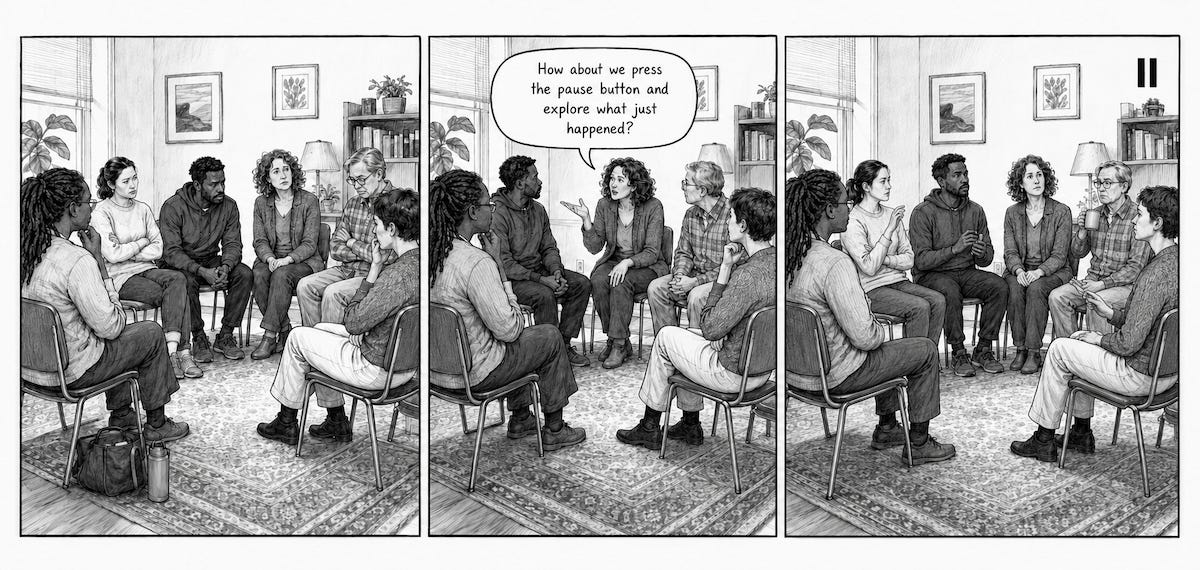
We can share: “What you said really resonated with me.”
We can express things in a room full of strangers that we may never choose to say to those closest to us.
Why?
Because two of the foundations of a group are confidentiality and respect. What is said in the group stays in the group.
Something as simple as agreeing to confidentiality can create enough safety for some to bring themselves more.
And what if I do not feel that is enough?
This I have heard more than once. And I always say: sharing where you are is enough for now and this may not always be so.
An added layer is the presence of facilitators who can support communication and exchanges by asking reflective questions or simply noticing patterns in the group and offering them for exploration.
“What are these groups for anyway?” is another question that has taken many an evening of those facilitated personal development groups.
Is the discussion useful?
It may be for some.
However, I feel that having a themed group is more supportive of an understanding of the central purpose of the group and avoids the initial confusion of being there expecting the facilitators to explain what a personal development group is.
If the group’s theme is Belonging, Visibility and Self-Trust, that gives a starting point for people to share how they feel about these themes in their own lives, without making them the only themes that will come up in the group, as this is unpredictable.
The theme is a container, not a restriction.
It is impossible to predict all the themes that can come up in a group as it will depend on the people who attend and what each of them brings. What is predictable is the day and time the group will take place, the weekly cadence, the ground rules the group will agree to on the first evening, and the importance of confidentiality and respect.
Joining a group without any experience of individual therapy is not only possible, but for some people it may actually feel less pressurised than being the only person in the room with a therapist.
One of the things that makes groups powerful is discovering that you are not the only one who feels this way. It is beautiful to witness someone express their feelings about something and find that someone else feels the same way.
That moment of…
I am not alone with this.
It can be immensely healing for some and for others it can be a first step in a new direction, which may not have seemed possible before.
Groups can provide what in Gestalt we like to call “the safe emergency”. The opportunity to try something new out in an environment that is contained.
Where there is room to press the pause button.
To reflect on what it was like to do that thing we have never dared to do before.
While being witnessed by others.
Groups can also provide acceptance and support in ways we may not have experienced before when we show vulnerability and uncertainty. Groups can give so much in a short space of time and that is what I love about them.
You may have read to this point and decided that a group is definitely your next step or you may still feel unsure whether a group is for you.
What I can offer you if you are still unsure is to think about what draws you towards a group.
Is it the possibility of experiencing something relationally different?
Is it the prospect of learning new things about yourself in relationships?
Is it curiosity about the difference from individual therapy?
Or is it the possibility of experiencing group therapy alongside individual therapy?
Equally, I’d invite you to explore what may be holding you back.
Is it the uncertainty?
Is it the prospect of being there alone?
Is it a feeling of not being prepared?
If so, we offer a 20-minute Zoom call to answer questions and get to know each other.
As in life, we can never have complete certainty, and that is what makes life and groups interesting and alive.
Curious about whether this group might be your next step?
You can find out more about our in-person Gestalt Therapy Group, Belonging, Identity and Self-Trust, including dates, fees and the application process, on the Groups and Workshops page.
This piece was first published on Kintsugi Mind, where you can subscribe to receive future posts.