I still remember that Tuesday in September, over a decade ago, when I sat in my first therapy group.
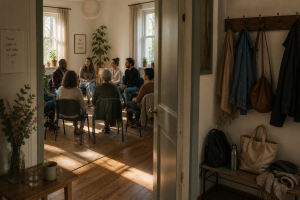
Before that, I was like other people who wonder what it is like to be in a therapy group.
I looked around me and assessed the people in the room as they were talking to each other. My palms were sweaty and my heart was racing. Back then, I was not great in a group setting as I found them really daunting.
Fast forward a decade, and I feel most alive and excited in a group therapy set up.
Living in a big city like London can magnify the sense of loneliness, how hard it can be to make plans materialise, and for some of us, the longing for the place we once called home.
We seek belonging in a place that, for some, feels different, or where we feel out of place and sometimes can be alienated. We can feel out of place for all sorts of reasons, our gender, sexual orientation, neurodiversity, race, origin…
The list is endless and yet we are all looking for the same thing.
To belong
To be part of a community
To be accepted for who we are
And all of these can happen in a group.
A therapy group can act as a micro system of a larger community where we can explore the bigger questions we may bring to therapy, but with multiple people at the same time.

And that can be quite extraordinary, in many ways.
Being in a group is the perfect ground for all our relational patterns to come to the fore. The best thing about this though is that when we are in a group, not only can we see them in action, but we also get to talk about them!
That feeling of being overlooked
Being intimidated by others
Not fitting in and having to put on a mask
Becoming overly functional
Needing to protect ourselves
And sometimes, others…
In a group, when someone feels a certain way, it is very likely that someone else will too, or will recognise something similar in themselves. That can be deeply validating. The sense that you are not alone in how you feel can begin to open things up in a different way.
I used to feel terrified of speaking in my group. Every week I would listen attentively to everyone. So many times I wanted to say “Me too!” in response to someone and yet, all I could manage was to nod vigorously, in silence.
All this changed for me the day someone said:
“I get really nervous about speaking in groups and I wonder if anyone else feels the same way.”
That was it!
My invitation
The way in
And out of my self-imposed silence
I looked at him and said:
“Me too. And I am so grateful for you to have said it.”
He nodded and smiled.
I was no longer alone. Alone in my group of one. Terrified to speak in a therapy group.
The thing I love most about groups is interactions like this. Where real life stuff happens and can be slowed down in a way that enables us to try something different, with enough support and sometimes a level of safety we have never experienced.
In Gestalt therapy, there is a concept coined in the seventies called “the safe emergency”. This is nothing more than trying something really scary in an environment that feels safe and contained enough.
Just like when I heard my peer share his feelings about speaking in the group, it allowed me to join him in his dread. Many other experiments can be made possible in a therapy group with the support of the facilitators and the group itself.
The beauty of groups is that they can feel daunting at the beginning. A room full of strangers. People who came for reasons we do not know unless they share. And that can feel unsafe at first.
As intimacy develops, the group can feel like the safest place we have ever experienced, or at least in a long time. We can feel seen, heard and understood. Sometimes for the first time in our lives.
Just like I felt when someone else shared a very similar experience to me.
Groups are alive.
Just like their members.
And just like interactions in the outside world, in groups we can also experience moments of disagreement, exposure, and sometimes disappointment. The vital difference is that in therapy groups we can explore these feelings within a frame that is rarely available outside of it.
And we can be met in those places in ways that are safe enough for us to stay and explore further rather than walking away from it. When we dare to do this, we can reframe safety and rewrite some of our own story in new terms.
As I explored in a previous post, what feels safe for one person can feel unfamiliar, or even threatening, to another.
As well as our baseline for what we feel is safe, the intersections we are part of will also influence how we may feel at different times in a therapy group setting. Some of us may have learnt that in order to be safe we had to fit in.
Agree with the majority.
Pretend everything is ok.
Say that we get it, even when we don’t.
Minimise our experience to make the other feel comfortable.
This is where the support of a facilitator is key.
When I facilitate a group, one of my jobs is to ensure that these things are not ignored but explored amongst the group.
Naming individual experiences can be a powerful and empowering thing to do.
When you said that … I felt …
I wonder if anyone else feels this way
How was it for you to hear?
With enough support, and a willingness to step a little outside what feels familiar, new possibilities can begin to emerge.
The basic ingredients for a therapy group are confidentiality, respect, openness and humanity.
I threw myself into the deep end when I joined a therapy group as I had never done therapy of any kind. And for me, it was a stepping stone for becoming a group therapist.
And I love being in a group now.
There is no right or wrong time to try group therapy and for some people there will never be a time.
And that’s ok too.
For some, attending a group after having been in individual therapy can be the perfect transition. For others joining a therapy group at a point of life transition can be a space for growth and reconnection.
Some may want a challenge to step out of their comfort zone
While others may stay in that zone a little longer.
If you have wondered what being in a therapy group might feel like, and something in this post resonated, wherever you are in this moment, you are welcome to get in touch.
Marta Carbajo Gutiérrez is a UKCP-accredited Gestalt psychotherapist working with individuals and groups in London and online. You can find out more about her way of thinking on her substack at Kintsugi Mind.